Introduction
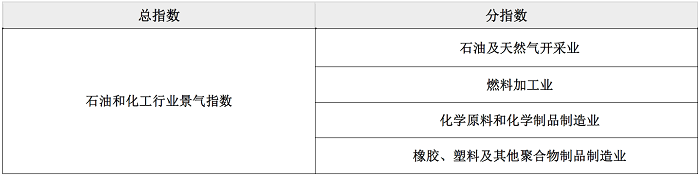
The Petrochemical Industry Economic Activity Index is jointly compiled by the China Petroleum and Chemical Industry Federation and Shandong Zhuochuang Information Co., Ltd., and is a microeconomic cycle monitoring index for the petrochemical industry, including the "Petrochemical Industry Economic Activity Index", "Fuel Refining Industry Economic Activity Index", "Chemical Raw Materials and Chemical Products Manufacturing Economic Activity Index", and "Rubber, Plastic and Other Polymer Products Manufacturing Economic Activity Index". The selection of the economic activity index for the petrochemical industry is based on the standard of measuring the potential output and economic benefits of the industry, including micro data of production and industry benefit data. The micro data of production include: capacity utilization rate, product profitability, and inventory level of finished products. The basic data comes from the regular research and evaluation results established with more than a thousand enterprises.
Core Summary
The recovery trend is still there; the index continues to decline driven by the off-season.
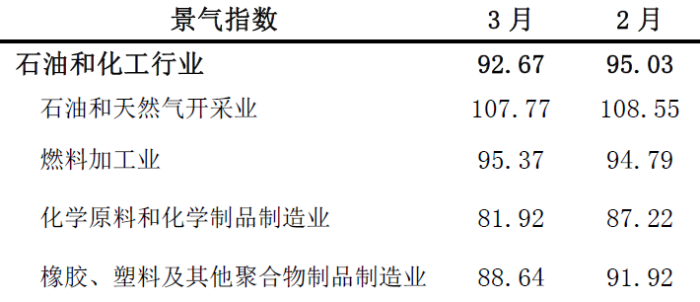
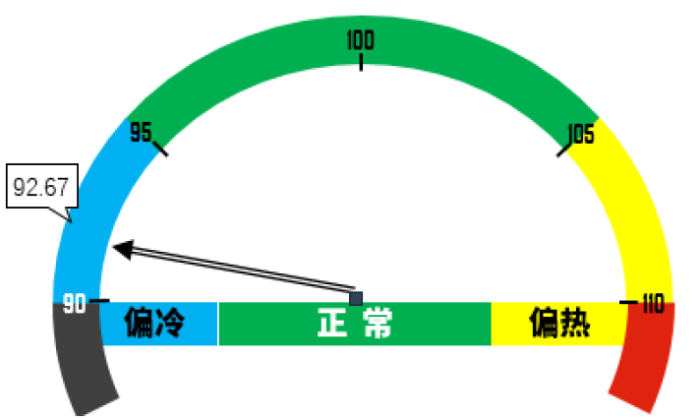
Continuing the downward trend in February,The Business Confidence Index for the Petroleum and Chemical Industry dropped to 92.67 in March 2023, entering the cold zone. Affected by the off-season, demand is sluggish, and the rubber, plastic, and other polymer manufacturing industries are still facing significant inventory reduction pressure. The Business Confidence Index has dropped into the cold warning zone, leading to a synchronous decline in the Business Confidence Index for upstream chemical raw materials and chemical product manufacturing industries. With the warming of temperatures and increased travel demand, the Business Confidence Index for the fuel refining industry has remained stable; the winter season has passed, and the air conditioning season has arrived, which has alleviated the low inventory pressure for crude oil and natural gas. Although the Business Confidence Index for the petroleum and natural gas extraction industry has continued the downward trend in February, it is still in the hot zone.
Index data
Business cycle
Focus on hotspots
The US and European central banks continue to raise interest rates, and the signs of the financial crisis are beginning to appear.
On March 16th, the European Central Bank raised interest rates by 50 basis points (BP). On March 22nd, the US Federal Reserve raised interest rates by 25 BP, once again emphasizing the 2% inflation target. On March 23rd, the Bank of England raised interest rates by 25 BP. As interest rates rise, liquidity continues to tighten, and the impact on global financial markets becomes increasingly apparent. On March 8th, the 16th largest bank in the United States, Silicon Valley Bank, was Runs on the bank, and two days later it collapsed and closed down, triggering panic in the financial markets. On March 12th, the US Signature Bank collapsed, and panic continued to spread. On March 19th, with the support of the Swiss National Bank, UBS urgently acquired the troubled Credit Suisse and fully wrote off the AT1 bonds, causing losses of more than 17 billion US dollars. Global risk aversion increased, and gold rose to over $2,000 per ounce, with the international crude oil price falling by more than $10 per barrel in a phase. At the end of March, as panic subsided, oil prices filled part of the gap.
Suggestions and Tips
Market expectations
The uncertainty of demand recovery has increased, and the market mood remains cautious.
Risk warning
Global inflation has declined, but core inflation remains high, and there is still room for interest rate hikes by the US and European central banks. The probability of a liquidity crunch triggering financial risks has increased, and the uncertainty of demand recovery has also increased. The coexistence of high inflation, high interest rates, and high risks may trigger a correction in commodity prices.
1. Overview of the prosperity of the petroleum and chemical industry
In March 2023, the Business Confidence Index for the Petroleum and Chemical Industry continued to decline, falling to 92.67, a decrease of 2.36 percentage points compared to February 2023, entering the cold zone; down 4.60 percentage points compared to March 2022, and the decline continued to narrow.
In March 2023, the strong rebound momentum of China's economy weakened, and the recovery process entered a stable period. According to the data from the National Bureau of Statistics, in March 2023, the manufacturing PMI slightly declined to 51.9, down by 0.7 percentage points from February. Under multiple favorable factors, the sales of China's real estate have recovered significantly, and the cumulative amount of sales by the top 100 real estate enterprises in the first three months has turned positive year-on-year. In February, the social financing increased by 1.95 trillion yuan more than the previous year, exceeding market expectations. Both corporate and retail medium and long-term loans have shown significant improvement, and the structural credit has also recovered significantly. On the international front, affected by the interest rate hike of global central banks, European and American banks and investment banks have encountered liquidity shocks, and the risk-aversion sentiment in global markets has intensified, causing serious shocks to the economic recovery. Except for precious metals, the prices of most commodities have declined to some extent. However, as the market panic subsided, they have recovered part of the decline, but the market's uncertainty about the recovery of demand has further increased.
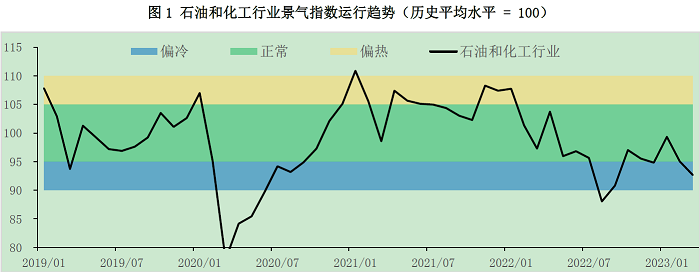
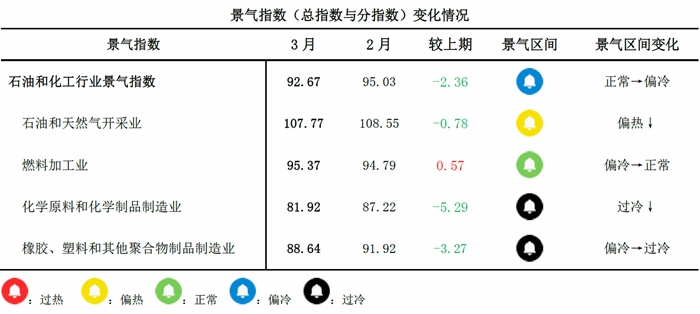
By industry, affected by the off-season, the demand side is sluggish. The rubber, plastic and other polymer manufacturing industries are facing significant inventory reduction pressure, and the index in March decreased by 3.27 percentage points compared to the previous month, falling into the over-cold zone. As its upstream, the chemical raw materials and chemical products manufacturing industries index decreased by 5.29 percentage points compared to the previous month, which is the largest decrease among the industries, and it is still in the over-cold zone. With the warming of temperatures and increased travel, the fuel refining industry's index increased by 0.57 percentage points compared to the previous month, which is the only industry with a positive increase. With the winter in the northern hemisphere has passed, the level of oil and gas inventory is still maintained at a relatively high level in the same period, and the international crude oil and natural gas prices have fallen significantly, and the energy crisis is fading out of the market's line of sight. The oil and gas extraction industry's index decreased by 2.36 percentage points compared to the previous month, and it is still in the hot zone. Overall, the total index of the petrochemical industry fell into the cold zone, which is the result of the off-season impact, but compared to the same period last year, the decrease has narrowed to 4.60 percentage points, which is the smallest decrease in the past 10 months, and the recovery trend is still continuing.
Second, Hot Issues Analysis and Future Prospects
1. The PBOC cut reserve requirements to support liquidity and the expectation of宽 credit further heated up.
With a number of positive policies implemented, social financing significantly warmed up in the first two months of 2023. The demand for liquidity continues to increase as the credit market heats up, and the central tendency of the interest rate for interbank financing has risen. The People's Bank of China has been extending the Medium-term Lending Facility (MLF) in excess of the required amount for several months. After the MLF was extended in excess, on March 17, the People's Bank of China announced a 25BP cut in the reserve requirement ratio (RRR), bringing the weighted average RRR for financial institutions down to 7.6%. This cut in RRR released about 500 billion yuan of long-term funds, met the credit demand, and kept the liquidity reasonably sufficient, which is conducive to supporting the economic recovery trend.
2. Liquidity crisis evolving into a financial crisis
In response to the economic impact of the pandemic, global central banks released a massive amount of liquidity, which indirectly led to the global great inflation. To combat inflation, the Federal Reserve raised interest rates by 25BP in March 2022, officially starting this round of tightening cycle. Compared to the previous tightening cycle (2015-2019), the speed and magnitude of interest rate hikes and balance sheet reductions have more than doubled. While the rapid tightening of liquidity has significantly suppressed inflation, it has also sown the seeds for a financial market crisis. During the pandemic, tech companies in the United States had ample cash flows, and Silicon Valley Bank, which mainly served tech companies, saw a significant increase in deposits. With a pressing demand for investment, Silicon Valley Bank heavily invested in fixed-yield bonds on its asset side. As interest rates rose sharply, bond prices fell, causing losses. On March 10, Silicon Valley Bank collapsed just 48 hours after facing a run, marking the first major bank failure in the United States since the 2008 subprime crisis. Due to the universal nature of Silicon Valley Bank's balance sheet structure, panic quickly spread through the financial markets. By the middle of March, a series of incidents, including the collapse of Signature Bank in the United States, the of Credit Suisse, and a sharp rise in CDS, began to emerge, and the liquidity crisis started to evolve into a financial crisis. To alleviate pressure on financial markets, the Federal Reserve and the European Central Bank provided emergency short-term liquidity support. The Federal Reserve, which was in the process of reducing its balance sheet, expanded its balance sheet by more than $390 billion in two weeks from March 8 to March 22, effectively resolving systemic risks in the U.S. banking system. Starting in late March, panic in the financial markets but the risk of a systemic financial crisis still exists. The goal of inflation reduction, maintaining financial market stability, and keeping economic growth have now formed an "impossible triangle," and U.S. monetary policy will bring greater uncertainty to the global commodity market.
3. Outlook for the prosperity of the petrochemical industry
The Petroleum and Chemical Industry Business Confidence Index continued to decline in March 2023, in line with seasonal characteristics, and the rapid narrowing of the year-on-year decline also confirmed the trend of long-term recovery. The domestic credit growth rate has stabilized, domestic demand is gradually warming up, and the situation is continuing to improve. On the international front, high inflation has increased the difficulty for central banks of various countries to combat inflation, and there is still a possibility of further interest rate hikes in the short term. The continuous increase in interest rates will also bring greater pressure to the financial market, and the risk of a global systemic financial crisis is still accumulating. In the short term, the panic caused by the small-scale crisis of banks and investment banks in the middle and early part of March led to a decline in the prices of bulk commodity markets. After the panic was alleviated at the end of March, the prices of bulk commodities filled part of the decline. In the medium term, the continuous tightening of liquidity will increase the possibility of a global systemic financial crisis, and the recovery of demand will also face greater challenges. It is expected that the Petroleum and Chemical Industry Business Confidence Index will continue to recover, with a relatively limited increase, and the probability of turning positive year-on-year is high.
Appendix
1. Index structure
2. Business cycle

3. Explanation of the Business Indicator
Production heat is an indicator of prosperity calculated by the industry production heat core algorithm based on the basic data of product price difference, production start-up, and inventory, reflecting the adjustments made by business managers to production and operation. It is more sensitive and accurate in reflecting the production and operation of enterprises, but its stability is lower than that of cost profit margin and inventory turnover rate.
Cost-profit ratio, an important indicator reflecting the level of industry input and output, is relatively sensitive in the benefit indicators and has stability. From the perspective of the micro-landscape cycle, a high cost-profit ratio is a proof of high prosperity.
Inventory turnover ratio, which reflects the turnover speed of inventory, indicates the liquidity of inventory and whether the amount of capital occupied is reasonable, and is the core indicator for measuring the utilization rate of corporate funds. Its stability and sensitivity are between the production heat and the cost profit rate.
Source: China News Service